The Rise of Non-USD Stablecoins Tokenized Finance

%20(1).jpg)
Table of contents:

Real-world assets (RWA) are moving from traditional financial infrastructure to blockchain. In 2026, asset tokenization is becoming an increasingly important part of the digital asset and financial markets landscape. An asset that traditionally exists in a banking registry, investment fund, securities account, or physical vault can now be represented as a token and transferred using blockchain infrastructure.
However, most tokenized financial markets are still heavily dependent on the US dollar. The US dollar remains the dominant reserve currency and the primary denomination for stablecoins and tokenized assets. But many markets operate in other national currencies, and institutions outside the US may require local-currency settlement for regulatory, operational, or economic reasons.This creates an important infrastructure gap.
Non-USD stablecoins can provide the local-currency settlement layer for tokenized assets, while on-chain FX infrastructure can connect markets denominated in different currencies.
Together, these technologies create a potential architecture for multi-currency tokenized finance:
RWA tokenization → local-currency stablecoins → on-chain FX → cross-border settlement.
This report examines the role of non-USD stablecoins in RWA markets, the current state of the market, major currencies and use cases, regulatory considerations, and the infrastructure required to connect tokenized assets with local-currency liquidity.
What Are Non-USD Stablecoins?
A non-USD stablecoin is a stablecoin designed to maintain a one-to-one peg with a currency other than the US dollar.
Examples include stablecoins pegged to:
- Euro (EUR)
- Singapore Dollar (SGD)
- Russian Ruble (RUB)
- Brazilian Real (BRL)
- Japanese Yen (JPY)
- Swiss Franc (CHF)
- British Pound (GBP)
- Australian Dollar (AUD)
- Turkish Lira (TRY)
- Korean Won (KRW)
- Chinese Yuan (CNH)
Stablecoins are usually associated with USD-denominated assets, but the underlying concept is not limited to the US dollar. The crypto market is global by design, while payment systems, financial regulation, and economic activity remain largely organized around national currencies. As a result, local-currency stablecoins can become an important bridge between blockchain-based financial infrastructure and domestic financial markets.
According to the research underlying this report, more than 25 non-USD stablecoins can currently be identified across major blockchain networks, including Ethereum, Tron, Polygon, Stellar, Solana, Base and Plasma.
Examples of Non-USD Stablecoins by Currency
Why Do Non-USD Stablecoins Matter for RWA?
The core promise of real-world asset tokenization is broader and more continuous access to financial assets through blockchain infrastructure. But tokenization does not remove the need for currency settlement. RWA assets such as bonds, investment funds, real estate, and commodities can be denominated in local currencies, including euros, yen, won, and reais. If the corresponding blockchain settlement happens exclusively in USD, every transaction can introduce an additional foreign-exchange conversion.
This creates a structural currency mismatch.
For example: Non-USD RWA → USD stablecoin settlement → FX conversion → local currency
A local-currency stablecoin can simplify this architecture: Non-USD RWA → local-currency stablecoin → local settlement
The difference becomes especially relevant for financial institutions and payment providers operating outside the US.
Local-currency stablecoins can potentially keep settlement closer to the currency in which an asset, liability, or transaction is originally denominated.
The Current Liquidity Gap
Non-USD stablecoin liquidity remains significantly smaller than USD stablecoin liquidity. According to the report's market data, tokenized RWA already has a measurable DeFi layer on the dollar side, with approximately $7.4 billion in lending and DEX volume in Q2 2026.
Comparable on-chain liquidity infrastructure is not yet available at the same scale for non-USD currencies. This creates a potential bottleneck for the growth of tokenized assets in Europe, APAC, Latin America, and Africa.
Euro Stablecoins: The Largest Non-USD Stablecoin Segment
The euro is currently the largest non-USD stablecoin segment identified in the research. The report tracks 26 euro-denominated stablecoins, representing approximately $853.98 million in total assets.
Two issuers account for the majority of this market:
- EURC by Circle: approximately $530.7 million, or 62.1%
- EURCV by Société Générale: approximately $172.8 million, or 20.2%
Together, these two stablecoins represent approximately 82.3% of the tracked euro stablecoin market. Other euro-pegged stablecoins remain much smaller by market capitalization, but they demonstrate that the infrastructure is developing across multiple blockchain networks and issuer models.
.png)
Regulation and the Growth of Euro Stablecoins
Regulation is becoming an important factor in the development and distribution of non-USD stablecoins. In Europe, the Markets in Crypto-Assets Regulation (MiCA) establishes a regulatory framework for crypto-assets and stablecoins operating within the EU. The introduction of regulatory requirements changes the market-access conditions for stablecoin issuers and can influence which assets are available to users and institutions. The same relationship between regulation and stablecoin infrastructure can be observed in other markets.
For example, the research highlights the development of:
- EURR, a euro stablecoin associated with Revolut;
- JPYC, a Japanese yen-pegged stablecoin operating within Japan's regulated financial environment.
The broader market structure therefore increasingly depends on the interaction between:
local regulation → licensed issuance → distribution → liquidity → institutional adoption.
For euro stablecoins, passporting and licensing can determine where a token can legally circulate. However, regulatory authorization does not by itself determine who ultimately controls the issuer or how operational risks are managed.
European RWA and Tokenized Money Market Funds
One of the clearest examples of European RWA adoption is the tokenization of money-market and government debt instruments. Spiko is an example of a European fintech platform connecting traditional cash-management products with blockchain infrastructure.Its model involves tokenized fund shares backed by high-quality Eurozone Treasury bills, providing blockchain-based access to yield-bearing instruments.
This illustrates an important relationship between RWA and non-USD stablecoins:
tokenized financial assets need corresponding settlement and liquidity infrastructure.
As more European financial assets are denominated in euros, euro-denominated stablecoins and other forms of digital euro liquidity can become increasingly relevant to their on-chain distribution and settlement.
Non-USD Stablecoins as On-Chain FX Infrastructure
Another major use case for non-USD stablecoins is on-chain foreign exchange (FX).
Today, stablecoin-to-stablecoin currency conversion can often work similarly to a conventional decentralized exchange swap.
For example: EURC → USDC
The exchange rate depends on available liquidity in the relevant pool. When liquidity is limited, larger transactions can experience significant slippage.
This creates an important limitation when decentralized liquidity pools are used as FX infrastructure.
What Is On-Chain FX?
A dedicated FX infrastructure can use a matching and settlement mechanism designed specifically for currency conversion. One important concept is payment-versus-payment (PvP) settlement.
PvP means that both sides of a transaction are settled together:
either both legs settle, or neither settles.
This differs from a simple sequential transfer where one party may send one currency before receiving the other.
An on-chain FX engine can therefore potentially provide:
- pre-defined exchange rates;
- synchronized settlement;
- reduced settlement risk;
- faster execution;
- stablecoin-based transaction fees;
- automated settlement between different currencies.
This infrastructure is particularly relevant when tokenized assets and payment systems operate across multiple currency zones.
Circle and Stablecoin FX Infrastructure
Arc, a blockchain developed by Circle, positions stablecoin FX as one of its infrastructure use cases. The architecture is designed around synchronized settlement rather than relying exclusively on available liquidity in decentralized pools.
Circle's existing infrastructure also supports the movement of USDC across multiple blockchain networks through its transfer infrastructure. The research identifies USD and EUR as the currencies currently most relevant to this architecture, while additional local currencies are being explored for institutional payments and settlement.
At the same time, an open question remains around whether such infrastructure becomes a broader shared FX layer for the non-USD stablecoin market or primarily remains part of a specific issuer's ecosystem.
Stablecoins vs Tokenized Deposits vs CBDCs
The terms stablecoin, tokenized deposit, and CBDC are often used interchangeably, but they represent different financial instruments.
The distinction is particularly important for institutional RWA infrastructure because the legal claim, issuer, redemption mechanism, and access model can affect how an asset is integrated into a financial product.
Non-USD Stablecoins and Tokenized Real-World Assets
Non-USD stablecoins can serve as settlement assets for multiple categories of tokenized real-world assets.
The key point is that RWA tokenization and currency tokenization solve different problems.
RWA tokenization represents the underlying asset on-chain.
Non-USD stablecoins represent the currency used to transact and settle that asset.
On-chain FX infrastructure connects the two.
Non-USD Stablecoin Market in 2026
According to the report's market data, the total stablecoin market reached approximately $310 billion+ in 2026. The non-USD stablecoin segment has grown by approximately 25% year over year, reaching more than $2 billion.
The largest non-USD currency segments identified in the research include:
- Euro
- Russian Ruble
- Brazilian Real
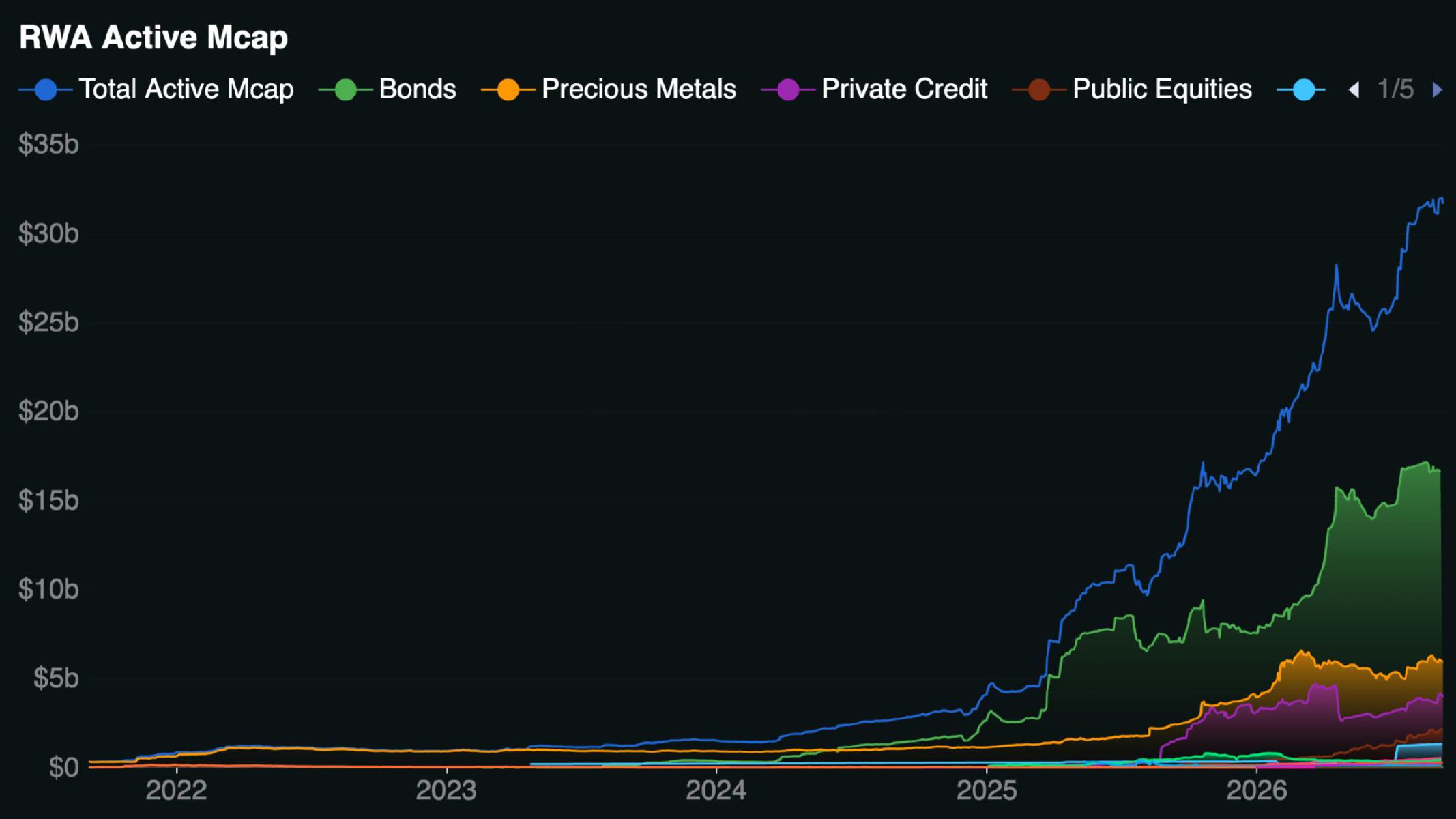
At the same time, the RWA market continues to expand. The report estimates RWA active market capitalization at more than $31 billion by September 2026.
Companies and platforms identified as active participants in the RWA market include:
- Securitize
- Spiko
- Ondo
- Tether
- Franklin Templeton
Tokenized Deposits and Institutional Blockchain Infrastructure
Tokenized deposits are another important part of the transition toward blockchain-based financial infrastructure. Unlike stablecoins issued by independent companies, tokenized deposits represent commercial bank deposits in a digital format. Banks including Citi, JPMorgan, and HSBC have explored tokenized deposit and blockchain-based settlement infrastructure through institutional and private-chain initiatives.
The potential institutional use cases include:
- faster movement of corporate liquidity;
- programmable settlement;
- treasury management;
- cross-border payments;
- automated redemption;
- institutional asset settlement.
Public blockchain adoption may depend on how financial institutions address privacy, liquidity exposure, counterparty risk, and regulatory requirements.
Risks of Non-USD Stablecoins
The growth of non-USD stablecoins also introduces a number of infrastructure and market risks.
1. Depeg Risk
Non-USD stablecoins with limited trading activity can face significant price-discovery problems.
If exchange listings disappear or decentralized liquidity becomes too thin, the market may no longer provide an efficient reference price for the token.
This makes liquidity an important part of stablecoin stability.
2. Reserve Transparency
A stablecoin's stability depends partly on the quality and transparency of its reserves.
Important considerations include:
- reserve composition;
- frequency of attestations;
- independent verification;
- redemption mechanisms;
- proof-of-reserves infrastructure;
- issuer disclosure.
A claim that an asset is backed 1:1 should therefore be assessed together with the available evidence supporting that claim.
3. Liquidity Risk
Non-USD stablecoin liquidity remains concentrated in a relatively small number of assets.
Thin liquidity can result in:
- higher slippage;
- limited institutional trading capacity;
- difficulty using the asset as collateral;
- greater sensitivity to market shocks.
For non-USD stablecoins to become infrastructure for institutional RWA markets, deeper and more reliable liquidity will be required.
Stablecoin Regulation: License vs Operational Protection
Regulatory authorization is an important market-entry requirement, but it does not eliminate operational risk. A license can determine whether and where an issuer is legally permitted to distribute a token.
It does not necessarily guarantee:
- insurance for holders;
- uninterrupted redemption;
- a managed wind-down process;
- comprehensive operational disclosures;
- protection against issuer failure.
For institutions considering stablecoin infrastructure, regulatory status should therefore be evaluated alongside reserves, custody, redemption, governance, technology, liquidity, and operational risk.
Key RWA Asset Classes and On-Chain Applications
Real-world asset tokenization can be applied across a broad range of financial and physical assets.
The Future of Multi-Currency Tokenized Finance
The next stage of RWA infrastructure is not only about putting more assets on-chain.It is also about connecting those assets to the currencies, liquidity, payment systems, and financial institutions that already exist in the real economy.
This creates three distinct infrastructure layers:
1. RWA Tokenization
Traditional financial or physical assets are represented as blockchain-based tokens.
2. Currency Tokenization
National-currency liquidity is represented through stablecoins, tokenized deposits, or other digital money instruments.
3. On-Chain FX
FX infrastructure connects assets and liquidity denominated in different currencies.
The resulting architecture can be summarized as:
RWA tokenization → non-USD stablecoins → on-chain FX → cross-border settlement.
For financial institutions, payment providers, banks, investment companies, and enterprises operating across multiple jurisdictions, this infrastructure can become an important component of blockchain-based financial systems.
How Rock'n'Block Can Build Non-USD Stablecoin and RWA Infrastructure
Rock'n'Block develops blockchain infrastructure for businesses working with tokenized assets, digital currencies, and institutional financial products.
Our capabilities include:
- RWA tokenization
- Non-USD stablecoin integration
- Smart contract development
- On-chain settlement infrastructure
- FX and payment infrastructure
- Tokenized asset platforms
- Blockchain infrastructure
- Smart contract audits
- Institutional blockchain solutions
From tokenizing the underlying asset to integrating the settlement currency and building the required blockchain infrastructure, the architecture can be designed around the specific regulatory and business requirements of the project.
From RWA Research to Continuous Market Intelligence
A market report provides a snapshot of the current market.For companies operating in RWA, stablecoins, tokenization, and digital finance, however, market conditions change continuously.
Rock'n'Block can turn market research into a dedicated market intelligence solution built around a company's specific business needs.
The service can include:
- Custom market coverage
- Continuous data updates
- Monitoring of key players and projects
- Custom metrics and benchmarks
- Alerts on relevant market developments
- Recurring intelligence delivered to your team
Interested in turning this research into a dedicated market intelligence solution? → Schedule a call with the Rock'n'Block team.

%202.jpg)




%201.webp)